Feb 11, 2012 | The Good Word
There’s a really cool story in 2 Kings 6 that I was thinking about this morning. There was this prophet called Elisha with skills that surpassed Jason Bourne and James Bond combined when it came to espionage. A couple thousand years before phones could be tapped or bugs could be planted, Elisha could listen in on the conversations the King of Syria was having in his own bedroom from miles and miles away.
And that was a useful skill because the king of Syria was waging war against Israel. So he’d tell his servants, “We’re going to camp here” or “This is the plan” and then Elisha would tell the king of Israel: “Watch out! Don’t go this way — the Syrians are gonna camp there…”
{Pretty cool gift, huh?}
After questioning which one of his men was a spy, the Syrian king eventually found out that Elisha was to blame, so he sent his servants to go capture him.
Sneaking out in the night, horses, chariots and a big old army, they surround the city where Elisha and his servant were staying. Elisha’s servant woke up the next morning, saw the army surrounding the city and got a little scared.
Probably more than a little scared.
But Elisha encouraged him with these words (words I love to cling to.) “Do not fear, for those who are with us are more than those who are with them.”
And then Elisha prayed for the servant: “Lord, I pray, open his eyes that he may see.”

God opens the servant’s eyes, and he sees that the mountain is full of horses and chariots of fire, all around Elisha.
{Afterwards, Elisha prays for the Lord to strike the army with blindness. The Lord does, and then Elisha tells them they’re going the wrong way in the wrong city, and offers to lead them to the man they’re after. He leads them to Samaria and the king of Israel prepares a feast for them (instead of killing them) and sends them back to Syria.
And how funny must that have been, (to everyone but the king) when the army rolled back into Syria and said, “Well we didn’t find the guy, but dang those Israelites throw down a banquet with skill!”}
The concept of the difference between seeing and truly perceiving is so rich in this story. Elisha’s servant wasn’t blind when Elisha prayed that God would enable him to see. There was a different type of seeing — a different perception of the situation that Elisha wanted his servant to have.
When the servant got that new perspective, he probably went from despair to elation in a matter of moments.
Similarly, Jesus often spoke to the Pharisees about the fact that they were truly blind. Though none of them was blind in the literal sense, yet still, they did not see and perceive the truth about who Jesus was when He walked among them, taught and healed right before their eyes.
The longer I walk with the Lord, the more often I come to the realization that if I feel like things are a mess in my own life, it’s usually because I have the wrong perspective. I might not be blind, but I don’t really see.
I call the things looming in front of me mountains because from my perspective, that’s what they look like. But when I give them over to God, trust Him, and ask for His eyes to see, He turns the mountains into molehills… or sometimes just shows me that they were molehills all along.
A lot of people asked Jesus for healing. And a lot of people asked Jesus to help them see. I have this picture in my mind of Bartimaeus — blind and sitting on the side of a road with orange-tinted dirt.
Jesus hears him calling, stands still, and commands for him to be called.
I wonder why He didn’t just walk over to Bartimaeus, but I think perhaps He wanted us all to understand this:
A man who can’t see can still find his way to Jesus.
I picture it in my mind, Bartimaeus jumping up and throwing his cloak off. When he hears that Jesus is calling for him, he runs to Him.
Jesus asks what he wants Him to do for him, and I imagine a peaceful smile, a man who can’t see turning his face toward Jesus. Bartimaeus asks for his sight.
Jesus says “Go your way; your faith has made you well.”
Bartimaeus immediately begins to see, and then follows Jesus on that orange-dirt road. Seeing it all for the first time.
I think there are a lot of situations in my life when I don’t see Jesus, even though He is right in front of me. Maybe it’s the same for you?
But what if we decided to throw aside our hindrances? What if we decided to run to Him — whichever direction we hear His voice coming from?
If we turn our faces to Him and ask “Lord, help me see” — isn’t that a prayer He answers?
Perhaps I’d recognize that the discouraging circumstances weighing me down are actually opportunities for Him to do something amazing in my life, something that will bring Him more glory.
I might see the tight financial situations we’ve been in as moments where He has shown us exactly who He is — the God who can and will provide. I’ve learned so much practical, life-enriching stuff while learning to stick to a tight budget. I can also see how God has expanded my capacity, and strengthened my faith muscles, when I flexed them with trust day by day.
And today, though a few things in my life feel “up in the air” and I don’t feel completely settled, and though I feel like I’m waiting for answers, somehow I get that sense again — He is at work. He is broadening my spiritual shoulders, preparing me for what’s to come.
Like the lessons in my year at the Pawn Shop — ones that prepared me for the mission field in a way nothing else could — if I ask for help to see my circumstances, I am sure I will see purpose, hope, an opportunity to grow, and a chance to be a part of something glorious.
How does life look to you at the moment? Do you need help seeing? Turn your face toward the One who can open your eyes. Ask for His help to see.
I’m confident you’ll see things differently. I’m confident it will be glorious.
xCC
Feb 10, 2012 | Hometastic Goodness
After we took down the Christmas decorations, I’ll be honest with you, I was more than a little bummed. We’ve been blessed with a place to live that’s fully furnished, which is absolutely amazing (and can you think of a better scenario for folks coming off the mission field who need to save up to buy a place of their own?). But the Christmas decorations made being in someone else’s already-decorated place feel a lot more like our home, and warm and home-y.
But by mid-January, it really was time to take things down. So then I thought adding a little pre-emptive Valentine’s flair might warm things up again, in preparation for spring when maybe I’ll find something else to pull out and our stuff will hopefully arrive and I can at least throw a few picture frames I bought on the side of the road in Gordon’s Bay onto the wall and say “Look, that’s me and the Bear and the Eiffel Tower!”
Okay, the Bear and I.
It took me so long to get around to completing those Valentinish crafts that they’re actually perfectly timed for the actually holiday. So there ya go.
I thought I’d share a few sweet little heart ideas in case you’re feeling crafty and want to spruce up for absolutely no reason. Although Saint Valentine, legend has it, was a very brave and important believer — but that’s a story for another post.
Now I’ll warn you, if you’re going to be offended that I am about to tear up a terribly old book that is moldy and water damaged and actually needs to be thrown out just to make some paper hearts, look away. Click over to an old post or something. It’s gonna happen.
I ripped some pages out of an old book and began cutting and playing around with hearts of different shapes and sizes.
I layered some different colored hearts with the book page ones and glued them together and stuck them on yarn and took pictures which will not upload but it didn’t look that good anyway.
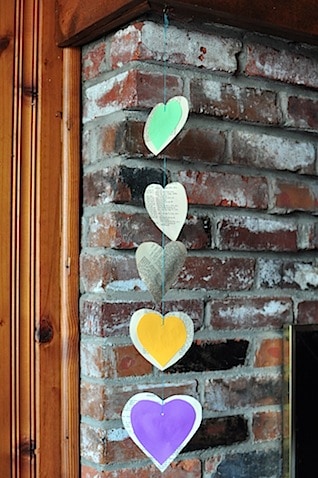
I then pulled the hearts off the yarn and threaded several through a single piece of thread I’d doubled over. In case you’re like me and need more instructions:
Poke holes in your hearts.
Pull yourself a long piece of thread, double it over and tie both ends of it in a knot around the needle.
Thread it through the hole in a heart from back to front, then loop it up and back through the hole a second time. Make sure to go in between the two pieces of thread the second time, or else you’ll just be undoing what you just did. (If that doesn’t make sense just try it and you’ll see what I mean.)
Leave enough space to place the next heart where you want it, and follow the same procedure.
Shampoo, rinse, repeat and voila!
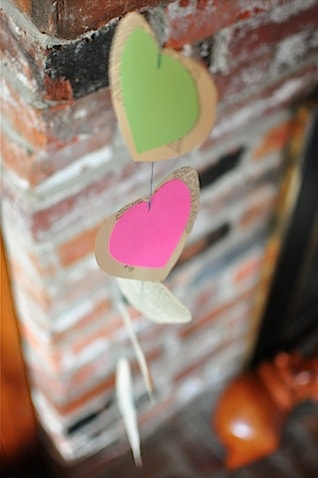
1. Le Dangly Garland
A lil sum fin sweet like this will emerge which you can hang from that naked hook on the mantle, or a doorknob. Keep out of reach of Tanks.
I also decided to make a heart garland, just with book paper, which seems romantic and the end result could possibly be used not just at Valentines maywhobiddyhaps.
I folded over a sheet of book paper and cut around a heart I’d already traced, but left a little of the fold un-cut at the top of each of the heart’s humps. Like so.
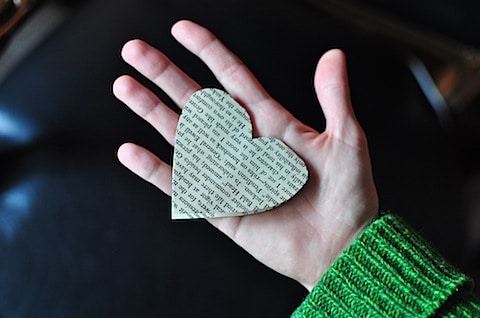
And then I used a long piece of thread and placed my sweet hearts gently over side by side, and with a little dab of glue, I pinched them closed and voila! Aren’t we feeling French today?
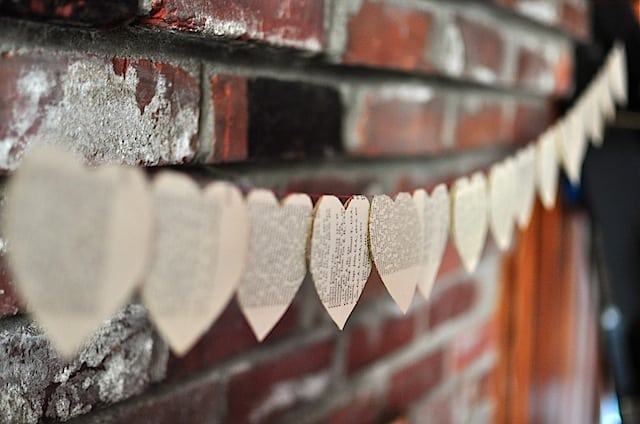
2. Le Romantic Book Paper, Mon Chéri.
I think this’ll be cute in our bedroom later. The Bear likes it.
And oh yes I did repurpose the sweet little polka-dots of a Krispy Kreme box.
A couple of cut-out hearts glued together with a string of yarn in between…happy on a door knob or a fridge handle but keep out of reach of Tanks!
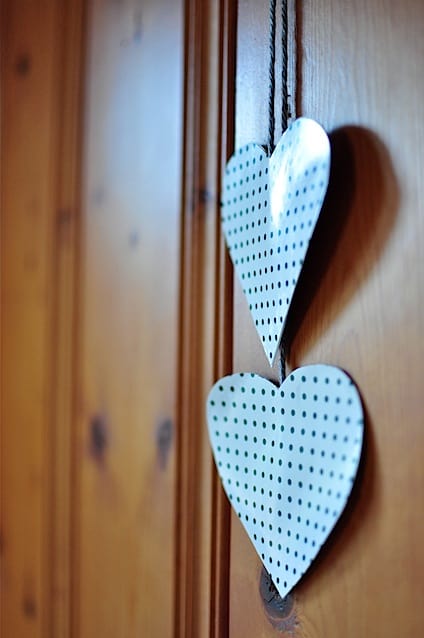
3. La fête du Krispy Kreme
One last little crafty idea for some hometastic Valentine goodness: Grab one of those old book paper hearts you’ve already cut out. (I think newspaper would work just as nicely by the way. Feel free to soak it in some tea and let it dry to stain it if you really want a vintage feel.)
Starting at the bottom, cut following the edge of the heart about 1/8th of an inch in, just tracing along the shape of the heart inwards, gently and carefully for as long as you can go, around and around toward the centre.
You can glue it gently to a happy colored piece of craft paper and…
The result should be something like this, which will make a lovely Valentine for the Hubs next week, and I’ll be proud.
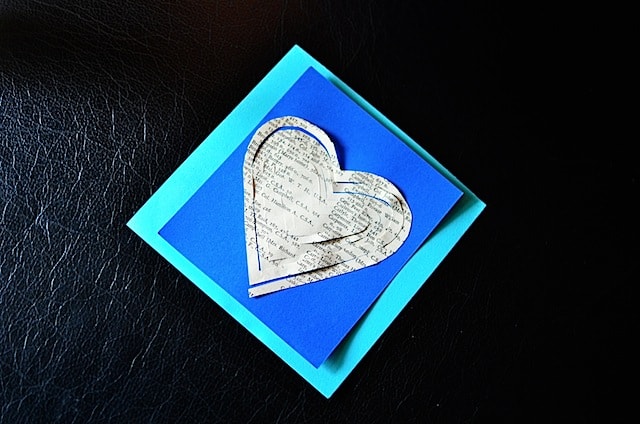
4. L’amour du Papier (Love of Paper)
I just thought those were a few fun ideas worth sharing. Let me know if you try one! Do you decorate for Valentine’s Day?
xCC
Feb 9, 2012 | Baby Photos
We noticed a mishap of gargantuan proportions recently. The reason for radio silence around here is, primarily because we are working on launching a local photography business — more on that later — and secondarily (do I ever make sense?) because we had to get a new Mac, since a laptop that can only edit eight photos an hour does not make photography a possibility for one Hero Hubs.
Said Hero Hubs moved all my stuff over to the new computer as well — it has a big screen and is nice to work on, but between #1 and #2 we’ve been working hard ’round these parts.
Now as I was saying in the midst of these movements, we discovered among our photo collections a serious mishap, which was that I never posted the absolutely schmadorable Eight Months photos we took of the Tank. Knowing we’re rounding the corner on a year and I can create a nice big post full of links so that you can review the year at your leisure (or else I’ll compile them all because who can be bothered to click so many links) it felt wrong not to have these photos somewhere around here, so that they too can join the lineup when we look back — and how has all this time passed anyway?
Eleven months photographs have also been taken, since that milestone just passed. But the Eight Month ones are appearing first, because they’re so dang late.
Moving along, eight months was a rather good time for the Blakester.

His first two teeth were emerging, and he was excited about eating meat. Like any good South African baby boy.

But, it’s really difficult to get this kid to smile for the camera. As you can see.

He’s like a stone wall, really.

A sad amount of cheer in his disposition.

At eight months, the crawl was developing nicely.

Swiftly followed by extra helpings of mischief.

And ridiculously adorable sneezes.

It’s just too bad we couldn’t get him to smile for you this time.

There’s always next month.
{Which is actually eleven months since we’re a bit out of order. Anywho.}

Ready for the mischievous “I’m ready for Baby Gap” big finish?

Boo-yow.
Thanks for bringing us heaps of joy, wee boy!

Elevensies are on the way!
End note: if the Tank looks Ginger in these photos, I think it’s just the coloring. He doesn’t seem nearly so red-headed in real life these days. His brother’s the one born in Scotland, anyway.
xCC
Feb 3, 2012 | An Expat, The Good Word
I‘ve been speaking about a simple principle as I’ve witnessed it in South Africa over these past two years {the principle that without discipline nature will take over again} and I would now like to take a moment to speak about hope, and how all this can apply to our spiritual lives. {You can read part one here.}
For many of us, when we first answered the call to follow Jesus, we might remember a sharp about-face. That’s the way repentance should be: it is often described as if you are walking in one direction, and you make a one hundred and eighty degree turn, and start heading in the opposite direction.
The call to follow Jesus is often a call to swim upstream. It is a call to walk in ways that are contrary to our nature: loving our enemies, praying for our persecutors, learning that greatness is synonymous with service and that the last will be first. It is a call to choose love over fear, trust over worry.
We can start the race with these things in mind, eager to follow closely, to find the crosses we are called to bear and carry them with vigor and wholehearted enthusiasm. But over time, nature tends to take over, even in our own hearts.
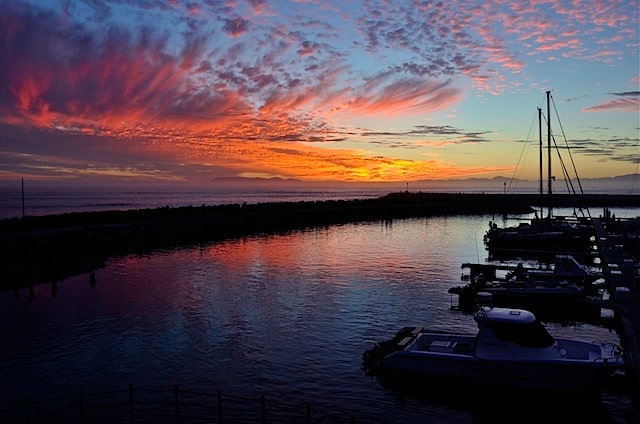
Our natural tendencies will surface and resurface as we navigate the refining fires of a life of faith. Like gold being purified by fire, when things get hot, the undesirable elements begin to rise to the surface.
Zeal and ardent enthusiasm will only carry us so far. We will need discipline to overcome — to pass through those fiery furnaces and allow the Lord to remove the old nature in us as it rises to the surface.
But over time, we may become careless about matters that we were once committed to taking seriously as a part of our desire to follow the Lord. Perhaps it’s the words we are willing to allow out of our mouths, or the commitment to spending time in prayer, or studying God’s word and applying it to our lives.
Without discipline, nature takes over again.
Thankfully, no situation is without hope. With forethought and commitment, things which were allowed to go wild can be subdued and domesticated. Just as old roads can be rebuilt and repaired, so the tongue can be tamed and re-tamed. The wildfire of political corruption can be put out, just as the corruption in our own hearts can be made to acquiesce under the Lordship of Jesus.
None of this will be possible without a patient kind of discipline. In the case of a country, it is a united and sustained effort towards a common goal. In the case of our own souls, what is needed remains much the same.
There is great depth to the truth that the Crucifixion that brought us forgiveness was a lengthy and sustained affair. Jesus patiently submitted to the abuse and punishment of a mocking trial, a scourging, and hours of torture on a cross. He wasn’t shot or stabbed and he didn’t face the electric chair or a lethal injection. Our forgiveness wasn’t won with a sprint. It was paid for with a marathon — and endurance.
Could this be why Hebrews admonishes us:
Therefore, we also, since we are surrounded by so great a cloud of witnesses, let us lay aside every weight, and the sin which so easily ensnares us, and let us run with endurance the race that is set before us, looking unto Jesus, the author and finisher of our faith, who for the joy that was set before Him endured the cross, despising the shame, and has sat down at the right hand of the throne of God. (Heb. 12: 1 & 2}
It goes on to say, “For consider Him who endured such hostility from sinners against Himself, lest you become weary and discouraged in your souls.” {v. 3}
Indeed, the chastening of discipline has the promise to produce good fruit: “Now no chastening seems to be joyful for the present, but painful; nevertheless afterwards it yields the peaceable fruit of righteousness to those who have been trained by it.” {v. 11}
When the Hubs was training in the pool, in his days as a Swimming Champion and Olympic hopeful, he constantly meditated on the motto that pain was good. “No pain, no gain…” kept him pushing through another lap, strengthening his arms and legs to slice through the waters faster and faster.
But the race isn’t always to the swift. The seed that falls on good ground doesn’t spring up as quickly as the seed that falls in rocky places. We are called to a race akin to the marathons held in Greece in the first century that Paul alluded to when he spoke of running toward the prize.
Though our salvation is absolutely a gift of grace, yet the call to follow is simultaneously a call to become a disciple, to take up a cross. We can trust His yoke is easy and His burden is light. Still, there is a weight we are called to carry.
In Romans 12:2, Paul urges us not to be conformed to the image of this world {a world where we’re encouraged to “do what feels good” or to “follow your instincts”} but to be transformed by the renewing of our minds. He ends those words with this promise: “Then you will be able to test and approve what God’s will is–his good, pleasing and perfect will.”
Nature has a way of taking over again. But in God’s glorious goodness, for a beloved country or a beloved soul, there is always, always hope for transformation.
xCC
Feb 3, 2012 | An Expat, South Africa
I am an American, born to American parents who were born to American parents who were born to American parents. I don’t know that I have any African heritage in my history, though I feel adopted by that beautiful continent by virtue of my time there and my deep love for one of Africa’s sons. I ask for grace to speak about South Africa, and hope to do so with humility, because even after living here for two years, I remain an outsider, looking in. {Foreword side note: I wrote this post a few weeks before we left South Africa last year.}
I‘ve observed more of the complicated nature of the country of South Africa in my last couple of months here than perhaps in the past couple of years of living here. This could be because I have just lately been watching the news, or because we are travelling around South Africa and it is giving me the opportunity to see.
I have noticed a pattern throughout my travels in this beautiful country, and it is one that gives me concern for the country’s future. In different ways, wherever I look, I see evidence that nature is taking over again.
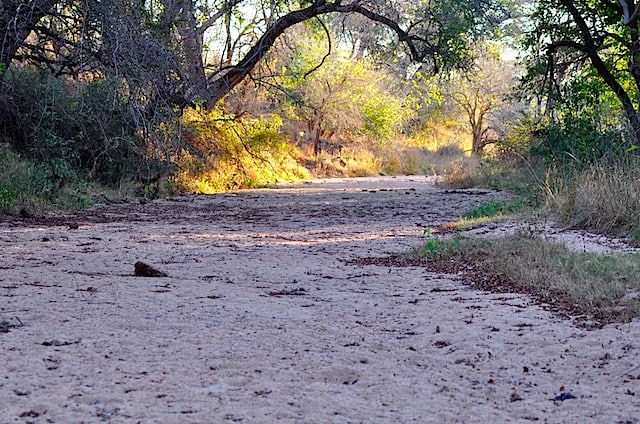
In Bloemfontein, the sidewalks and curbs are crumbling, and the streets are littered with potholes. In Johannesburg, buildings once great and sturdy sites for businesses, have fallen into complete ruin, not even safe for the homeless to live in. We travel the roads with concern, as some have fallen into such disrepair they are almost impassable. In many corners of the country, it seems infrastructure is lacking to fight the bush fires that break out, which means they ravage acres upon acres of land.
There are small and simple examples, too: The children’s play area where we were staying in the Drakensberg was falling apart and clearly not being maintained. Trash was being left outside and the baboons were having a rarely hindered field day.
It is evidence of a simple principle that applies to all of life: without discipline, nature takes over again.
My husband speaks of the South Africa he grew up in, and I see both joy and sorrow in his eyes. It is a place that once was and is not likely to ever be again. On our way up to the Kruger, we pass a picnic area. He tells stories of precious family holiday memories — he and his brother and sister would pile into the backseat of the family car early in the morning, and the family would travel for a while and then stop to enjoy the breakfast they’d packed at one of those picnic areas on the roadside.
A lot of things were wrong then, but some things were right.
Today those picnic areas are no longer maintained, and even where they are, it is not always safe to stop. The one we passed that sparked the story was overgrown with weeds, the table cracked, the cement benches crumbling. “No one will come to repair it,” he remarked with sadness. “And it will just fall into ruin.”
If I had to describe the situation in South Africa at present, I could only use one word: complicated. We had a very positive life experience when we lived in the Western Cape. It is the only province of the country ruled by a political party other than the ANC. When we are there, I feel hopeful about SA’s future.
But in Mpumulanga near Kruger National Park, in the Gauteng and Johannesburg, or in the Drakensberg in the province of KwaZulu Natal, there are so many signs of decay and disrepair, it is more difficult to maintain a sense of hope.
“My family used to take a drive through that valley, up that way,” my husband explains while we’re in the Drakensberg, “but I asked someone at reception, and the roads have eroded so badly, they’ve closed them.”
The truth is, the maintenance of a country takes discipline. To keep the roads in good form requires planning ahead, and hiring individuals who are qualified to build roads. But the political agenda of empowerment has meant that people without the skills and knowledge to successfully build or repair a road are being hired to do so. Thus, the roads that are being rebuilt are crumbling quickly — they have not been built properly, and trucks with oversized loads are travelling them because no one is taking the initiative to firmly regulate the trucking industry.
I understand the desire to attempt to even the playing field, and to give a previously oppressed people group a hand-up, but at what cost? The crumbling of a country? The oppression of another people group?
I remember Mandela’s very important words, spoken after Apartheid had ended and he was elected: “Never, never, and never again shall a people group be oppressed in this nation by another.”
I’m afraid I see evidence to the contrary.
To combat the forces of nature which seek to hinder the prosperity of a nation takes discipline. The discipline to successfully uphold the law in all cases. The discipline to budget and plan ahead for the maintenance of a country’s road and railway systems. The discipline to carefully protect the natural resources which are the country’s greatest wealth, be it wildlife or diamonds or coal (through regulation rather than nationalisation, I would humbly digress to note.)
It takes discipline to keep peace, rather than to pit one people group against another for the furtherance of a political agenda.
Without discipline, nature will succeed in taking back what was once hers. Roads will naturally crumble over time. People will naturally begin to blame one another for their troubles, and violence will be the result. Without discipline, laws will become suggestions or rules that only apply to some of the people some of the time.
Without discipline, nature takes over again.
Do you see evidence of nature taking over again in your own life? I’m planning to share more on this subject tomorrow.
xCC
{You can read part two of this post right here.}

 I create resources to help people find deeper, more meaningful relationships with God through pursuing, pondering, and prayer. The "Shop" link above will take you to the home of many of the lovely resources I’ve created to help you keep walking one day deeper with Jesus.